One of the fastest ways to weaken leadership… is answering too quickly. And most CEOs do not realize they are doing it.
In fact, many leaders believe the exact opposite. They believe responsiveness is leadership. They believe being available proves commitment. They believe fast answers create momentum.
And in the early stages of growth, that often appears true. The CEO solves problems quickly. The company moves fast. Decisions happen efficiently. The organization grows. From the outside, it looks like strong leadership.
Yet beneath the surface, something else is quietly being built. Dependency.
The Pattern Most CEOs Never Notice

I recently spoke with a CEO who said something many leaders eventually feel, even if they rarely say it out loud.
“I feel like everyone still needs me for everything.”
Every issue. Every decision. Every question.
At first glance, it sounded like a team issue. Yet the deeper we explored it, the clearer the pattern became. This was not a capability problem. It was a leadership pattern that had been reinforced for years. Because over time, the organization had learned something very important: where the real thinking happened.
How Dependency Gets Created
Dependency rarely gets created intentionally. It gets created through repetition.
A team member brings a question. The CEO answers immediately. The issue gets solved quickly. Everyone moves on. And because it feels efficient, the pattern repeats. Again. And again. And again.
Until eventually, the organization learns: “We bring the problems. The CEO brings the thinking.”
This is subtle. Yet powerful. Because once that pattern becomes cultural, behavior changes across the organization. People stop wrestling with problems long enough to develop deeper thinking. They escalate issues earlier. They wait for guidance faster. They seek confirmation before moving.
Not because they lack intelligence. Yet because the environment trained them to depend on the leader’s clarity.
The Hidden Cost of Being Highly Capable

Ironically, this pattern is often created by highly capable CEOs. The more competent the leader… the more tempting it becomes to answer quickly. After all, they usually do have the answer. They see patterns faster. They understand thThe Hidden Cost of Being Highly Capable
Ironically, this pattern is often created by highly capable CEOs. The more competent the leader… the more tempting it becomes to answer quickly. After all, they usually do have the answer. They see patterns faster. They understand the business deeply. They can often solve the issue in minutes.
And because of that, speed becomes their leadership identity.
- “I’m the one who figures things out.”
- “I’m the one who keeps things moving.”
- “I’m the one who carries clarity.”
That identity creates success early on. Yet at the next level, it creates a hidden ceiling. Because organizations do not scale through one person’s thinking. They scale through distributed thinking.e business deeply. They can often solve the issue in minutes.
And because of that, speed becomes their leadership identity.
- “I’m the one who figures things out.”
- “I’m the one who keeps things moving.”
- “I’m the one who carries clarity.”
That identity creates success early on. Yet at the next level, it creates a hidden ceiling. Because organizations do not scale through one person’s thinking. They scale through distributed thinking.
The Leadership Shift Most CEOs Resist
At a certain point, leadership must evolve. The CEO must move from solving every problem to developing stronger thinkers. From being the answer source to becoming the environment where clarity expands. And this shift is uncomfortable. Because answering feels productive. Pausing feels inefficient. Silence feels awkward.
Yet the strongest CEOs eventually discover something counterintuitive:
Growth often happens in the space leaders try to eliminate.
The Power of the Pause
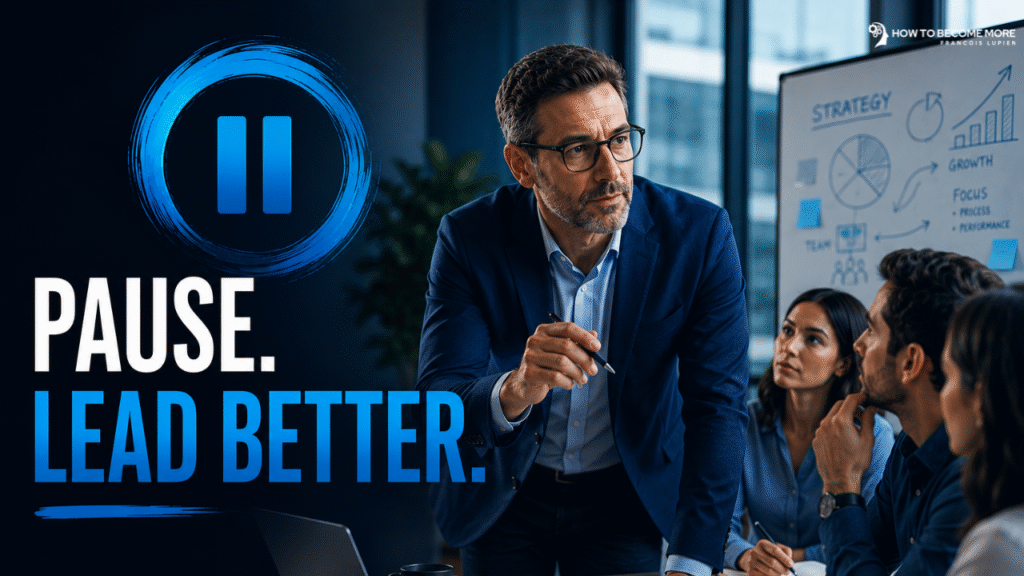
One of the most underestimated leadership tools is the pause. The moment after someone asks a question… and the CEO does not immediately answer. That moment changes everything. Because now the team member must think. Not react. Think.
They must process the issue, explore possibilities, form perspective, develop ownership. This is where leadership capacity begins to grow inside the organization. Not when answers are provided. When thinking is required.
Why Most Leaders Struggle With Silence
Silence exposes something deeper. Identity. Many CEOs unconsciously connect their value to having answers, being decisive, being needed, resolving tension quickly. So when silence appears, discomfort rises. The instinct becomes: “Let me solve this.”
Yet often, the issue is not the problem itself. The issue is the leader’s discomfort with allowing the thinking process to unfold. That is an entirely different conversation.
The CEO Power Move Most Leaders Miss
The power move is not dominating the conversation. It is resisting the urge to rescue too quickly. Not to manipulate. Not to appear powerful. Yet to create space for development.
This changes the role of leadership completely. Because now the CEO is no longer simply solving operational problems. They are shaping the thinking culture of the organization.
The 3-Question Test Every CEO Should Use

Before answering a question, pause and ask yourself three things. These three questions reveal far more than communication habits. They reveal leadership identity.
- “Does this actually require my answer?”
This is the first filter. Because many issues reaching the CEO do not actually require the CEO. They simply followed the path of least resistance. The organization learned: “If we ask the CEO, we’ll get clarity faster.” And because leaders are capable, they answer. Yet every unnecessary answer strengthens dependency. This question forces the CEO to examine where dependency exists, where ownership is weak, where escalation has become automatic. Sometimes the greatest contribution is not answering. It is redirecting responsibility back to where growth should occur.
2. “Am I answering because it’s necessary… or because silence feels uncomfortable?”
This is the deeper question. And often the more revealing one. Because many CEOs answer quickly to relieve emotional tension. Not strategic tension. Emotional tension. Watching someone struggle through uncertainty can feel uncomfortable. Watching silence linger can feel inefficient. Watching imperfect thinking emerge can feel frustrating. Yet that tension is often where growth begins. When leaders interrupt the process too early, they unintentionally interrupt development. This is difficult for high performers. Because high performers naturally want to move things forward. Yet mature leadership understands: not all speed creates growth. Sometimes slowing the response strengthens the organization.
3. “What happens to this person if I answer immediately?”
This question changes everything. Because now the CEO is no longer evaluating the problem alone. They are evaluating the developmental impact of their leadership response. Does the person become stronger, clearer, more capable, more confident — or more dependent? This question shifts leadership from transactional problem-solving to long-term capability building. And that is a completely different level of thinking.
Identity Framework
The Chief Excavation Officer™
This is where the CEO steps into the role of Chief Excavation Officer™. The Chief Excavation Officer™ looks beneath the surface. Not just at the operational issue. At the hidden pattern underneath it. Patterns like over-functioning, rescuing, controlling clarity, equating value with being needed, carrying the mental burden of the organization. This stage requires honesty. Because many CEOs eventually realize: they unintentionally created the dependency they now feel trapped by. Not because they lacked leadership. Because they cared deeply and moved quickly.
The Chief Expansion Officer™
Once the pattern becomes visible, leadership expands. Now the role changes. The CEO stops asking “How do I solve more?” and begins asking “How do I expand the thinking capacity of the organization?” That shift changes conversations, meetings, delegation, ownership, accountability, and leadership culture. Now the CEO asks: “What’s your recommendation?” “What do you think?” “How would you approach this?” “What am I not seeing?” And slowly, the organization begins to mature. Because the thinking is no longer centralized. It begins to distribute.
The Chief Execution Officer™
Not simply someone who executes personally. Someone who creates execution through expanded clarity across the organization. The Chief Execution Officer™ protects thinking quality, develops leadership capacity, avoids creating unnecessary dependency, and strengthens execution by strengthening perspective. This is a much more scalable leadership model. And frankly… a much lighter one.
Why This Feels So Different
Many leaders mistakenly believe this approach reduces authority. In reality, it strengthens it. Because true authority is not built on always having answers. It is built on creating clarity without needing to dominate every decision. The strongest CEOs in the world do not spend all day proving they are the smartest person in the room. They create rooms where strong thinking expands. That is leadership maturity.
The Real Reason CEOs Become Bottlenecks

Most CEOs do not become bottlenecks because they lack delegation skills. They become bottlenecks because their identity is tied to being needed, they answer too quickly, they carry clarity for everyone else, they unintentionally train dependency. And eventually, success itself creates exhaustion. Because everything still flows through them. Not operationally alone. Mentally. Emotionally. Strategically. That becomes heavy.
The Shift From Control to Capacity
This leadership shift is not about disengaging. It is about increasing organizational capacity. When the CEO pauses: thinking expands, ownership expands, capability expands, confidence expands. And over time, the organization becomes stronger because more people are thinking deeply. Not just the CEO.
A Reflection Worth Sitting With
The next time someone asks you a question… pause. And ask yourself: “Am I creating clarity… or dependency?”
That question alone can transform how you lead. Because the future of the organization is shaped by what leaders repeatedly reinforce.
The Leadership Shift That Changes Everything
Great CEOs do not build organizations that depend on their answers. They build organizations that expand their thinking. And that shift often begins with something deceptively simple: not answering so quickly.
Great CEOs come to me to sharpen their thinking in private so they can execute with precision in public.
I Promise Progress.
If this resonates with you, you know where to find me.