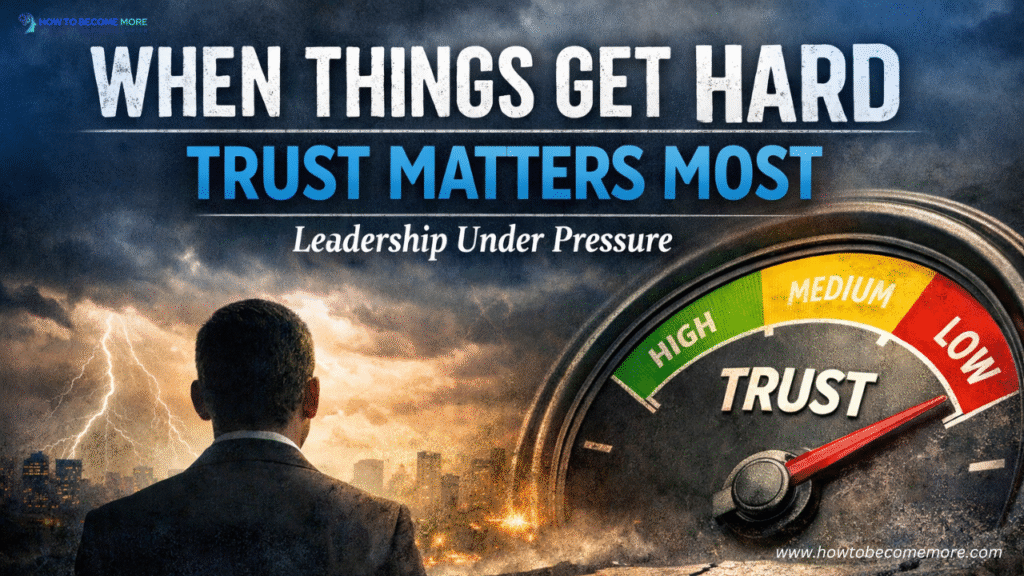
Every organization talks about trust. Few understand how fragile it becomes when pressure rises.
During stable periods, trust feels almost automatic. People assume competence. Execution flows. Conversations are easier.
Then conditions change.
Markets tighten. Decisions carry more weight. Uncertainty increases.
And suddenly, trust — which once felt solid — begins to wobble.
Most leaders respond the same way.
They communicate more. They explain more. They reassure more.
Yet the wobble remains.
Because in challenging times, trust does not break down due to a lack of information.
It breaks down due to instability at the point of leadership.
The Fundamental Misunderstanding About Trust
Most leaders believe trust is built through:
- transparency
- frequent updates
- alignment meetings
- clarity of message
These tools matter — in calm conditions.
Under pressure, they are insufficient.
When stakes rise, teams stop evaluating leadership logically. They evaluate leadership physiologically.
They stop asking:
“Do I understand the plan?”
And start asking:
“Can I rely on how my leader will show up when things get uncomfortable?”
In difficult moments, trust is less about words and more about predictability under stress.
Why Trust Is Assessed Differently Under Pressure

Human beings are wired for survival.
When uncertainty increases, the nervous system shifts priorities.
The brain looks for:
- safety
- stability
- reliable authority
In organizations, that authority is the leader.
Teams begin scanning for signals:
- Does my leader rush or steady themselves?
- Does urgency leak into the room?
- Are decisions reactive or grounded?
- Is emotional volatility present or contained?
These signals matter more than vision statements.
Because trust, in challenging times, is not a concept.
It is a felt experience.
The Real Reason Trust Erodes

Trust rarely erodes because leaders make hard decisions.
It erodes because leaders make hard decisions from compressed internal states.
When leaders are rushed, anxious, or internally overwhelmed, those states transmit — even when leaders believe they are hiding them.
This transmission happens through:
- tone
- pace
- body language
- decision rhythm
- emotional containment
Teams pick up these signals instantly.
Not consciously. Instinctively.
And when signals fluctuate, trust weakens.
Self-Regulation: The Hidden Foundation of Trust
Here is a truth rarely discussed in leadership circles:
Trust does not start with others. It starts with the leader’s ability to regulate themselves under pressure.
Human nervous systems synchronize.
In organizations, the leader’s emotional state sets the baseline for everyone else.
When leaders are regulated:
- teams settle
- execution improves
- initiative increases
When leaders are dysregulated:
- teams hesitate
- questions multiply
- risk tolerance drops
This is not psychology. It is biology.
The Difference Between Calm and Control
Many leaders confuse calm with control.
They believe trust comes from projecting certainty, confidence, or decisiveness at all costs.
Control tries to overpower uncertainty. Calm contains it.
Calm leadership does not deny difficulty. It absorbs pressure without leaking it.
Teams don’t trust leaders because they appear unshakeable.
They trust leaders because they appear steady.
The Three Signals Trusted Leaders Send in Challenging Times
Elite leaders foster trust by managing three signals — consistently.
Not occasionally. Not when it’s convenient. Always.
Signal #1: Pace Control

Anxious leaders accelerate when pressure rises.
They:
- speak faster
- compress timelines
- push urgency
They believe speed equals competence.
It doesn’t.
Speed under pressure signals danger.
Trusted leaders slow down slightly when stakes increase.
Not to delay action — but to stabilize the system.
That small adjustment communicates:
“We are not in immediate danger.”
Teams respond by thinking more clearly and executing more confidently.
Signal #2: Emotional Boundaries

Trusted leaders understand something critical:
Teams can handle hard truths. They cannot handle emotional volatility from authority.
Elite leaders do not process uncertainty publicly in high-stakes moments.
They do not:
- think out loud when decisions carry consequences
- vent anxiety in meetings
- offload fear onto the organization
They process uncertainty privately and show up contained.
This containment creates psychological safety.
Signal #3: Decision Discipline

Nothing erodes trust faster than decisions made from urgency.
Even good decisions lose credibility when they feel rushed.
Trusted leaders:
- pause before committing
- resist artificial deadlines
- explain decisions without defensiveness
- demonstrate thoughtfulness
Trust grows when teams believe:
“This decision was made from clarity.”
Why Predictability Is the Real Trust Builder
In challenging times, trust is not built through optimism.
It is built through consistency.
Teams trust leaders they can predict under pressure.
Not because those leaders are rigid — but because they are emotionally reliable.
Inconsistent leadership creates anxiety. Consistent leadership creates safety.
And safety is where trust lives.
The Quiet Cost of Unregulated Leadership
When leaders fail to regulate themselves, organizations pay silently.
It shows up as:
- second-guessing
- slower execution
- dependency on approval
- risk avoidance
- diminished ownership
These behaviors are not signs of weak teams.
They are signs of uncertain leadership signals.
Trust erodes not because of intent — but because of unpredictability.
A Simple Discipline That Builds Trust Immediately
Trusted leadership is not about personality. It’s about discipline.
Before any high-pressure interaction, ask yourself:
“What state am I about to transmit?”
Then adjust one variable:
- slow your speech by 10%
- shorten your message
- remove urgency from your tone
- ground your posture
This small shift changes the room.
Not because the content changed — but because the signal did.
Why Trust Cannot Be Delegated
Trust cannot be outsourced to HR. It cannot be repaired by culture initiatives. It cannot be solved through communication alone.
Trust flows from leadership presence.
Especially during challenging times.
When leaders regulate themselves first, trust follows naturally.
When they don’t, no amount of messaging compensates.
The Deeper Truth About Trust
Trust is not something leaders build intentionally.
It is something they earn indirectly.
By being:
- steady when things are uncertain
- consistent when pressure rises
- grounded when decisions are hard
Trust is the byproduct of leadership maturity.
Final Reflection
In challenging times, teams don’t need more information.
They need stability.
Trust does not start with communication. It starts with self-regulation.
Because when pressure rises, your team isn’t listening for answers.
They’re watching for steadiness.
I work with CEOs and top executives through confidential conversations that sharpen clarity, strategy, and leadership presence. – I Promise Progress –
If this resonates, you know where to find me.
Where We Go Next
Video #2 of the Trilogy: Why Teams Lose Trust When Leaders Rush Decisions
This trilogy is shaping into a signature trust authority arc.